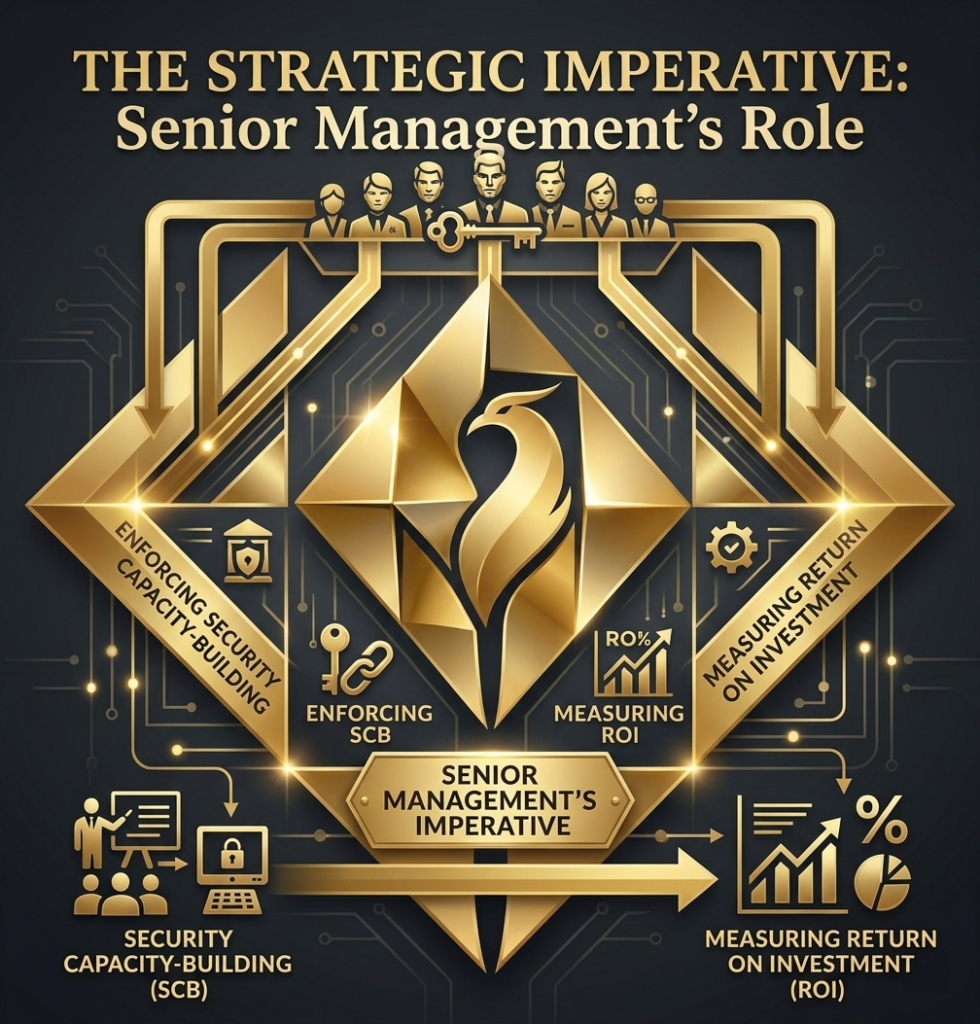
The Strategic Imperative: Senior Management’s Role in Enforcing Security Capacity-Building and Measuring Return on Investment
Doctoral Researcher, Swiss School of Management
Certified Security Management Professional, CSMP® by ISMI® – International Security Management Institute
Certified Corporate Training Expert by International Academy for Homeland Security – IAHS IAHS
Abstract
For decades, corporate security has been relegated to a reactive “cost center” framework, impeding its strategic integration and value. However, an evolving global threat landscape, coupled with new business paradigms such as matrix organizational structures and offshoring, necessitates a fundamental shift in this perspective. This paper argues that effective security is not a technical problem to be delegated, but a strategic leadership challenge that must be championed, enforced, and measured by senior management. Through a synthesis of literature from leading security organizations (e.g., ASIS, CPNI) and management theory, this paper analyzes the C-suite’s critical role in transforming security from a protective function into a business enabler. It examines the mechanisms for building human capacity through standardized selection and training, explores the enforcement of this capacity via a culture of motivation, and provides a framework for measuring Return on Investment (ROI) in a way that transcends simple loss prevention. The findings indicate that the modern Chief Security Officer (CSO) must evolve from a technical enforcer to a strategic educator, and senior management must provide the cultural and structural support for this transformation. The ultimate ROI of security capacity-building is measured not only in risk reduction but in organizational resilience, brand value, and competitive advantage.
1. Introduction
The traditional conceptualization of corporate security has been one of a necessary, albeit costly, organizational function. Often viewed as a “guard at the gate”, its primary role was perceived as loss prevention and asset protection. This perspective has historically led to a misalignment between security functions and core business objectives, with security departments struggling to gain C-suite attention, justify resources, or demonstrate tangible value beyond the avoidance of negative incidents. In this model, security is a cost center, and its leadership is often excluded from strategic planning.
However, the contemporary business environment renders this model obsolete. Three critical shifts have elevated the strategic importance of security:
- Evolving Business Structures: The rise of globalization has led to matrix organizational structures where management relies on influence across networks rather than direct hierarchical control. Furthermore, the practice of offshoring critical business functions to regions with different risk profiles challenges companies to “manage at a distance”.
- Evolving Threats: Security risks have become more complex, asymmetric, and networked, encompassing everything from global terrorism and organized crime to sophisticated information security threats. Corporate boards are now facing litigation and shareholder accountability for security failures, forcing them to treat risk as a board-level issue.
- Evolving Accountability: New forms of accountability, such as corporate governance and social responsibility, place added pressure on companies to ensure their operations are secure, ethical, and resilient, regardless of location.
These factors demand a new paradigm—one where security is redefined as “resilience” and viewed as a source of competitive advantage. This paper contends that this transformation is impossible without the active engagement and leadership of senior management. Effective security capacity-building is not merely a technical or training problem; it is a strategic imperative that must be championed, enforced, and rigorously measured by the C-suite to generate a positive Return on Investment (ROI).
This paper will first review the literature on the evolving role of senior security leadership. Second, it will analyze the formal mechanisms of capacity-building, focusing on selection and training standards. Third, it will present a discussion on how this capacity is “enforced” not through punitive action, but through the strategic implementation of a culture of motivation. Finally, it will propose an evidence-based framework for measuring the ROI of these initiatives, aligning security outcomes with strategic business goals.
2. Literature Review: The Evolving Role of Security Leadership
The C-suite’s role in security is facilitative and strategic. It begins with the appointment of a security leader who possesses the requisite skills to operate at a senior level and is empowered to execute a vision aligned with the business.
2.1 From “Corporate Cop” to Strategic Partner
The historical archetype of a security manager was the “corporate cop”—an individual recruited from a narrow talent pool of ex-police, military, or intelligence backgrounds. While possessing deep tactical knowledge, this profile often lacked the business acumen required for strategic alignment11.
The “new breed of Chief Security Officer (CSO)” represents a significant evolution. This role is developing much as the Chief Financial Officer (CFO) role did, transitioning from a technical accountant to a key strategic partner to the CEO. The modern security leader must be, first and foremost, a “business man who happens to have security expertise”. This shift is reflected in the Demos (2006) report, which emphasizes that the power of a security function is “directly proportionate to the quality of its relationships, not the depth of its content knowledge”.
This new model re-frames the security function’s purpose. It moves beyond simple protection to enabling the business to take risks. The goal is not absolute security, which is an impossibility, but “resilience”—the adaptive capacity to manage change and minimize damage when things go wrong.
2.2 The C-Suite Mandate: Aligning Security with Business Objectives
For a CSO to succeed, they must operate with a clear C-suite mandate. Security initiatives must be in “alignment with that mandate”, explicitly supporting the “overall objectives of the organization”. This requires the CSO to “manage up, down, and across”.
“Managing up” is the process of securing and maintaining C-suite buy-in. This is not achieved by emphasizing fear, but by demonstrating value. The modern CSO must be an “educator rather than an enforcer”, capable of re-framing the security conversation “away from mere loss avoidance and toward top-line growth through competitive advantage”. When security is integrated into corporate governance and brand value, it ceases to be a cost center and becomes a business enabler. Senior management, in turn, must “own” security and provide the CSO with the seniority and access required to influence strategy.
3. The Mechanics of Capacity-Building: Selection and Training
Before value can be demonstrated, capacity must be built. For the security sector, human capacity is the most critical component. Senior management’s role is to sponsor, fund, and mandate the implementation of professional standards for both selection and training.
3.1 Defining “Capacity”: Minimum Standards for Selection
Capacity-building begins at the point of recruitment. A motivated but incompetent officer is a liability. The ASIS International (2010) guideline on Private Security Officer Selection and Training provides a robust, defensible framework that senior management can adopt as corporate policy. This framework establishes minimum recommendations for employment screening. Key criteria include:
- Age and Education: Minimum age requirements (e.g., 18 for unarmed, 21 for armed) and possession of a high school diploma or equivalent.
- Background Verification: Verification of employment for at least the last seven years 28and submission to a fingerprint-based criminal history check.
- Criminal History: Candidates must not have been convicted of or pled guilty to a felony or job-related crime within a minimum seven-year period.
- Drug Screening: Candidates must undergo pre-employment drug screening.
By mandating these standards, senior management ensures a baseline of quality and due diligence, reducing organizational liability and building a foundation of trustworthy personnel.
3.2 Enforcing Capacity: Mandated Training Standards
Selection must be followed by comprehensive, standardized training. This is the core of capacity-building. The ASIS guideline recommends a tiered approach to training:
- Pre-assignment training: Covers fundamental knowledge before an officer is placed in the field.
- On-the-Job Training (OJT): Provides site-specific, practical instruction commensurate with the role.
- Annual Training: Ensures ongoing proficiency and updates on new policies or threats.
This structure is mirrored by regulatory bodies like the UK’s Security Industry Authority (SIA), which requires formal, licence-linked qualifications. The SIA curriculum, for example, includes modules on “Awareness of the Law,” “Health and Safety,” “Conflict Management,” and role-specific tasks such as “Access and Egress Control” and “Patrolling”.
Senior management’s role is not to design the curriculum, but to “set or approve standards of training” and create an organizational structure that “plays at an organisation-wide level” to ensure these standards are funded, implemented, and enforced universally.
4. Discussion: Enforcement Through a Culture of Motivation
Mandating selection and training standards builds potential capacity, but it does not guarantee actual performance. A competent officer who is unmotivated, disengaged, or resistant to change will fail to apply their skills effectively. Clark (2003) notes that motivation is the “energy that drives us to use our expertise” and that motivational programs can increase performance by 20 to 40 percent.
Therefore, the true “enforcement” of capacity is not a punitive or compliance-driven activity. It is the C-suite’s responsibility to foster an organizational culture that unlocks the motivation of its people.
4.1 The “Motivation Destroyers”: What Senior Management Must Stop Doing
Often, the most significant barriers to performance are “de-motivators” embedded in the organizational culture. Research synthesized by Clark (2003) and the CPNI (2013) identifies several key “motivation destroyers” that senior management must actively eliminate:
- Dishonesty, Hypocrisy, and Unfairness: The perception of unfairness is devastating to motivation. This includes unfair pay comparisons, “secret deals”, or inconsistent application of rules.
- Vague, Impossible, or Constantly Changing Goals: Without clear, concrete, and achievable goals, employees lack commitment and direction.
- Unnecessary Rules and Arbitrary Barriers: Cumbersome policies and rules that serve no clear purpose are a major de-motivator, as they communicate a lack of trust and hinder efficiency.
- Negative or Prejudicial Feedback: Feedback that focuses on the person (e.g., “you are careless”) rather than the performance gap (e.g., “the report was missing this section”) has been shown to depress performance.
4.2 The “Motivation Builders”: What Senior Management Must Champion
Eliminating de-motivators must be paired with the active promotion of a positive motivational culture. The CPNI’s (2013) comprehensive guidance on guard force motivation stresses that “organisational culture has been shown time and again to be the strongest driver of motivation there is”, and “the nature of the leadership at all levels… determines what the culture is”.
Senior management enforces capacity by building a culture centered on the following levers:
- Fairness and Recognition: Motivation is “not just about the amount of pay”. It is about recognizing good performance, rewarding it appropriately, and, “above all else listening to and engaging with your staff”.
- Communication and Job Design: Effective motivation stems from clear communication of goals and expectations. It is also rooted in a well-structured job, defined by Hackman and Oldham’s characteristics: skill variety, task identity, task significance, autonomy, and feedback.
- Support and Engagement: Managers must “walk the job”, provide positive support when things go wrong, and give employees a voice.
Case studies from the CPNI document illustrate this in practice. Birmingham Airport, after discovering low morale via the CPNI survey, launched a multi-year strategy focused on leadership development for managers, improving feedback mechanisms, and enhancing team building. Similarly, a VSG and Compass Group case study demonstrated that a focus on “Fairness” and “Poor Communication” led to interventions such as quarterly 1-to-1 meetings and daily welfare visits by management. In these cases, senior management sponsored and championed a formal “motivation project”, treating motivation as a manageable, critical business process.
5. Measuring the Return on Investment (ROI) in Security Capacity
For security to be perceived as a strategic partner, it must demonstrate its value. The “new breed of CSO” warns against wasting investment on “security activities rather than security outcomes”. An activity is “building a security team” or “buying a security product”; an outcome is a “measurable decrease in a known risk”.
The CPNI Motivation Performance Metrics provides a sophisticated framework for measuring these outcomes, dividing them into “lead” and “lag” indicators. This framework allows senior management to track the ROI of their capacity-building and motivation initiatives.
5.1 A Framework for Security Metrics
Senior management should require the security function to report on a balanced set of metrics, as illustrated in Table 1.
Table 1: Framework for Security Performance Metrics
(Adapted from CPNI, 2013)

This framework provides a tangible ROI. The “Lag Indicators” represent direct, calculable business costs. A reduction in staff turnover and absenteeism, for example, saves significant amounts in recruitment, training, and overtime costs. A reduction in theft, fraud, and security breaches provides a clear financial and operational return. The “Lead Indicators” function as a diagnostic tool, allowing management to see if their motivational and training interventions are taking root before the lag indicators are affected.
5.2 The Strategic ROI: Brand and Competitive Advantage
Beyond quantifiable metrics, the ultimate ROI is strategic. As noted by security experts, the CSO must “re-frame the security conversation… toward top-line growth”. A secure and resilient organization inspires “customer confidence”.
This allows the sales and business development teams to move “beyond overcoming security objections… to feeling comfortable leading with the security conversation”. When a company can prove it has a professional, well-trained, and motivated security force, security transforms from a liability into a key differentiator and a source of brand value. This is the highest form of ROI, and it is only achievable when senior management leads the initiative.
6. Conclusion
The role of senior management in the security sector has fundamentally shifted from passive oversight of a cost center to active, strategic leadership of a resilience-building function. This paper has demonstrated that this leadership is exercised through three integrated phases.
First, the C-suite must champion capacity-building by appointing a business-savvy security leader and mandating and funding professional standards for selection and training, as outlined by bodies like ASIS.
Second, senior management must enforce this capacity not through top-down control, but by actively fostering an organizational culture of motivation. This involves eradicating “motivation destroyers” such as perceived unfairness and poor communication, while actively building a culture of recognition, engagement, and support, as modeled in the CPNI framework.
Finally, senior management must measure the ROI of these initiatives by demanding a balanced scorecard of lead and lag indicators. This proves value not only through risk and cost reduction (e.g., lower turnover, less theft) but through the creation of a resilient organization that can use its security posture as a competitive advantage.
The “new breed of CSO”, supported by an engaged and educated C-suite, is the critical catalyst for this change. By aligning security with the core business mandate, senior management transforms security from a static shield into a dynamic enabler of business success.
References
ASIS International. (2010). Private Security Officer Selection and Training Guideline (ASIS GDL PSO-2010).
Briggs, R., & Edwards, C. (2006). The Business of Resilience: Corporate security for the 21st century. Demos.
Centre for the Protection of National Infrastructure (CPNI). (2013). Motivation within the security industry.
Chartered Management Institute (CMI). (2012). Motivating Your Employees in a Time of Change (Checklist 068).
Clark, R. E. (2003). Fostering the work motivation of individuals and teams. Performance Improvement, 42(3), 21-29.
Loder, C. (2016, June 15). The new breed of Chief Security Officer. LinkedIn. https://www.linkedin.com/pulse/new-breed-chief-security-officer-chad-loder
Security Industry Authority (SIA). (2015, August 1). Security Guard Training. https://www.sia.homeoffice.gov.uk/Pages/training-sg.aspx
Security Industry Authority (SIA). (2019, February). Introduction to Learning Leading Towards Licence-linked Qualifications.
Tarallo, M. (2015, April 1). Getting buy-in from the C-suite. Security Management. ASIS International.
PS: The article and the related paper include an AI citation(s).